Introduction
📌 1. Fundamentals & Key Effects
- Moving Charge / Current Carrying Conductor: Creates a magnetic field ($\vec{B}$) around it.
- Interaction: A moving charge or current-carrying conductor placed within an external magnetic field experiences a magnetic force.
👍 Right Hand Thumb Rule
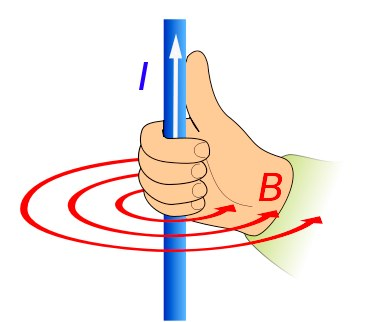
⚡ Imagine holding a current-carrying conductor in your right hand with the thumb pointing toward the direction of the electric current.
🔄 Then, your curled fingers will naturally encircle the wire in the direction of the magnetic field lines.
🎯 This simple rule is used to find the orientation of the magnetic field vector ($\vec{B}$) at any point around a straight wire.
🧲 2. Magnetic Field ($\vec{B}$)
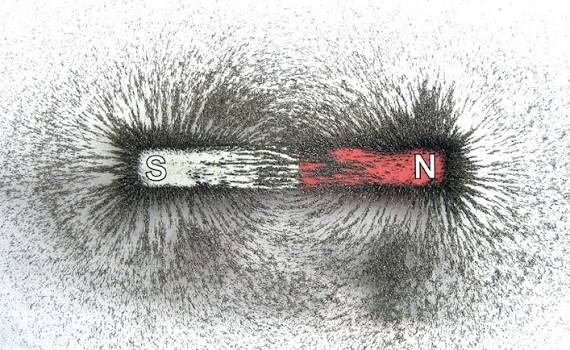
- Definition: The region around a bar magnet or a current-carrying conductor where its magnetic influence can be felt.
- Quantity Type: It is a Vector Quantity $\vec{B}$.
- SI Unit: Tesla (T).
📐 Dimensional Formula of $\vec{B}$:
Using the magnetic force formula:
$$F = BIl \implies B = \frac{F}{Il}$$
Substituting the dimensional formulas:
$$[B] = \frac{[MLT^{-2}]}{[A][L]}$$
$$\mathbf{[B] = [MT^{-2}A^{-1}]}$$
🧩 3. Superposition Principle
For multiple magnetic fields acting at a single point, the net magnetic field vector ($\vec{B}$) is the vector sum of individual magnetic fields:
$$\vec{B} = \vec{B}_1 + \vec{B}_2 + \dots$$

📜 4. Biot-Savart Law
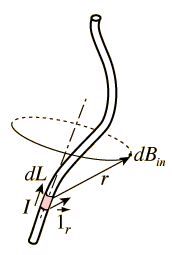
Statement: The magnetic field ($dB$) due to an infinitesimal small current element ($dl$) at a distance point ($P$) is directly proportional to the current ($I$), element length ($dl$), sine of the angle ($\theta$), and inversely proportional to the square of the distance ($r$).
💡 What is a Current Element?
It is the small section ($\vec{dl}$) of a conductor taken in the direction of the electric current.
- Mathematical proportionality: $$dB \propto \frac{I \cdot dl \cdot \sin\theta}{r^2}$$
- Scalar Equation:$$dB = \frac{\mu_0}{4\pi} \frac{I \cdot dl \cdot \sin\theta}{r^2}$$
- Vector Form:$$\vec{dB} = \frac{\mu_0}{4\pi} I \frac{\vec{dl} \times \hat{r}}{r^2}$$
🔍 Note: Here, $\mu_0$ is the permeability of free space. Constant Value: $\frac{\mu_0}{4\pi} = 10^{-7} \text{ T}\cdot\text{m}\cdot\text{A}^{-1}$
⚡ Special Cases:
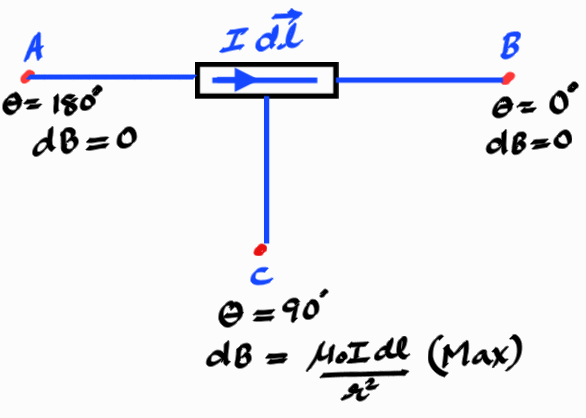
- Case I (On the Axis Line): If $\theta = 0^\circ$ or $\theta = 180^\circ$, then $\sin\theta = 0$. $$\mathbf{dB = 0 \text{ (Minimum)}}$$ 🚩 The magnetic field is zero at any point along the axial line of the current element.
- Case II (On the Equatorial Line): If $\theta = 90^\circ$, then $\sin 90^\circ = 1$. $$\mathbf{dB = \frac{\mu_0}{4\pi}\frac{I \cdot dl}{r^2} \text{ (Maximum)}}$$
📝 Solved Examples (NCERT Pattern)
🚀 Example 1
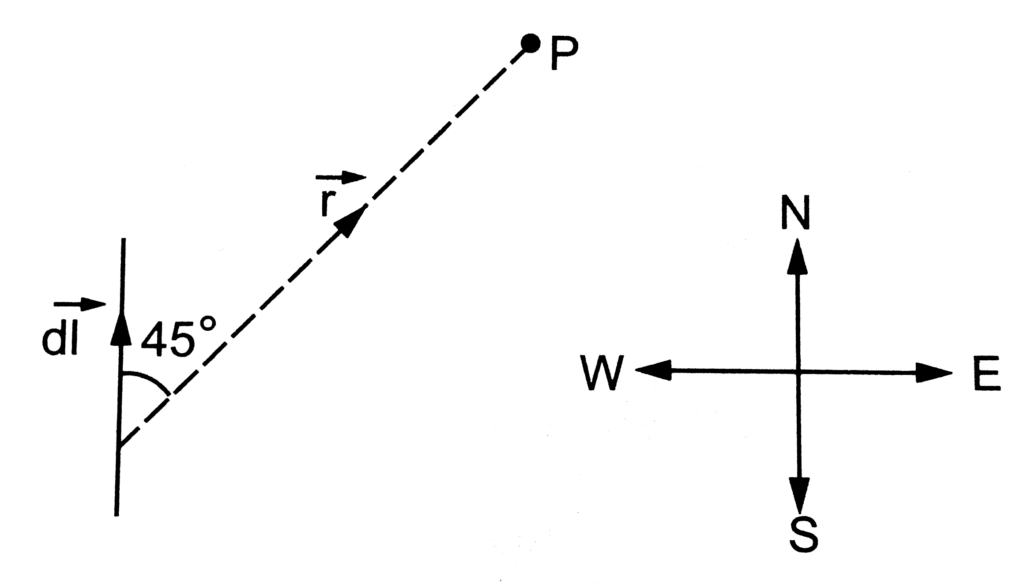
A wire placed along the north-south direction carries a current of $8\text{ A}$ from south to north. Find the magnetic field due to a $1\text{ cm}$ piece of wire at a point $200\text{ cm}$ north-east from the piece.
Solution: Given variables:
- Current, $I = 8\text{ A}$
- Length, $dl = 1\text{ cm} = 1 \times 10^{-2}\text{ m}$
- Distance, $r = 200\text{ cm} = 2\text{ m}$
- Angle (North-East orientation), $\theta = 45^\circ$
Using Biot-Savart law:
$$dB = \frac{\mu_0}{4\pi} \cdot \frac{I \cdot dl \cdot \sin\theta}{r^2}$$
$$dB = (10^{-7}) \cdot \frac{8 \times 1 \times 10^{-2} \times \sin 45^\circ}{2^2}$$
$$\mathbf{dB = 1.4 \times 10^{-9}\text{ T}}$$
👉 Direction: Normally into the plane of the paper.
🚀 Example 2 [NCERT | OD 19]
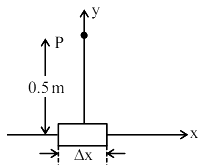
An element $\Delta\vec{l} = \Delta x \hat{i}$ is placed at the origin and carries a large current $I = 10\text{ A}$. What is the magnetic field on the y-axis at a distance of $0.5\text{ m}$? ($\Delta x = 1\text{ cm}$)
Solution: Given variables:
- Current, $I = 10\text{ A}$
- Length element, $dl = \Delta x = 1\text{ cm} = 10^{-2}\text{ m}$
- Distance, $r = y = 0.5\text{ m}$
- Angle between x-axis ($\vec{dl}$) and y-axis ($\vec{r}$), $\theta = 90^\circ$
Applying Biot-Savart Law:
$$dB = \frac{\mu_0}{4\pi}\frac{I \cdot dl \cdot \sin\theta}{r^2}$$
$$dB = \frac{10^{-7} \times 10 \times 10^{-2} \times \sin 90^\circ}{(0.5)^2}$$
$$\mathbf{dB = 4 \times 10^{-8}\text{ T}}$$
👉 Direction: The direction is determined by cross product $\vec{dl} \times \vec{r}$:
$$\vec{dl} \times \vec{r} = (\Delta x \hat{i}) \times (y \hat{j}) = \Delta x \cdot y (\hat{i} \times \hat{j}) = \Delta x \cdot y \hat{k}$$
Hence, the field $\vec{dB}$ points along the $+z\text{-direction}$ (Out of the page $\odot$).
🏠 Homework Problems (H.W.)
Problem 1
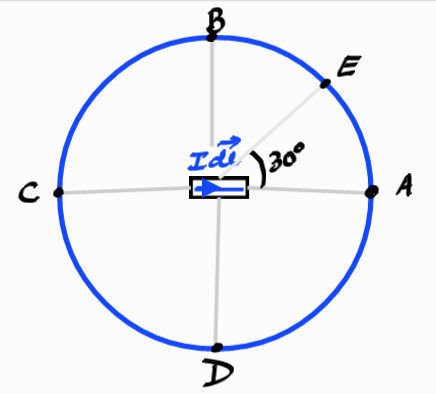
Given a circle of $1\text{ m}$ radius with a current element $Idl$ placed at its center. Find the magnetic field at boundary points $A, B, C \text{ and } D$.
$$\left[\text{Given: } \frac{\mu_0 Idl}{4\pi} = 10^{-5}\text{ in SI}\right]$$
Problem 2
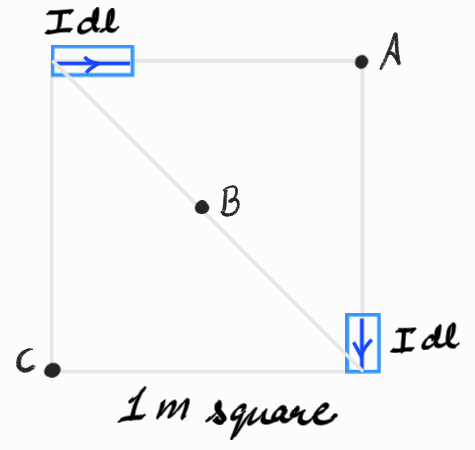
Find the magnetic field at points $A, B \text{ and } C$ due to a current element $Idl$ placed at the base corner of a square of side length $1\text{ m}$ as shown in the diagram.
$$\left[\text{Given: } \frac{\mu_0 Idl}{4\pi} = 10^{-5}\text{ in SI}\right]$$