Author: Learn Physics Conceptually

  • CHAPTER 4: MAGNETIC EFFECTS OF CURRENT โšก๐Ÿงฒ | PART-1

    Introduction

    ๐Ÿ“Œ 1. Fundamentals & Key Effects

    1. Moving Charge / Current Carrying Conductor: Creates a magnetic field ($\vec{B}$) around it.
    2. Interaction: A moving charge or current-carrying conductor placed within an external magnetic field experiences a magnetic force.

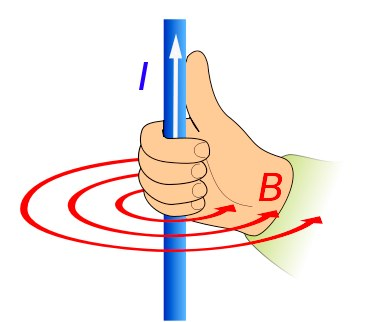
    ๐Ÿ‘ Right Hand Thumb Rule

    โšก Imagine holding a current-carrying conductor in your right hand with the thumb pointing toward the direction of the electric current.

    ๐Ÿ”„ Then, your curled fingers will naturally encircle the wire in the direction of the magnetic field lines.

    ๐ŸŽฏ This simple rule is used to find the orientation of the magnetic field vector ($\vec{B}$) at any point around a straight wire.

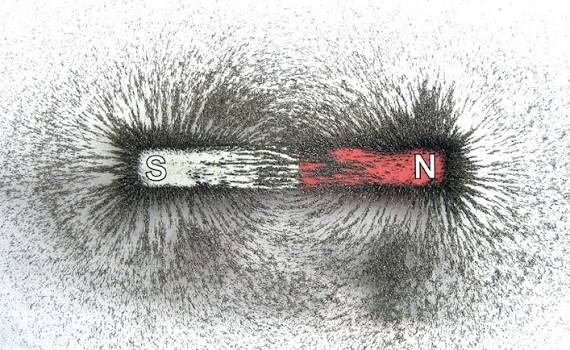
    ๐Ÿงฒ 2. Magnetic Field ($\vec{B}$)

    • Definition: The region around a bar magnet or a current-carrying conductor where its magnetic influence can be felt.
    • Quantity Type: It is a Vector Quantity $\vec{B}$.
    • SI Unit: Tesla (T).

    ๐Ÿ“ Dimensional Formula of $\vec{B}$:

    Using the magnetic force formula:

    $$F = BIl \implies B = \frac{F}{Il}$$

    Substituting the dimensional formulas:

    $$[B] = \frac{[MLT^{-2}]}{[A][L]}$$

    $$\mathbf{[B] = [MT^{-2}A^{-1}]}$$

    ๐Ÿงฉ 3. Superposition Principle

    For multiple magnetic fields acting at a single point, the net magnetic field vector ($\vec{B}$) is the vector sum of individual magnetic fields:

    $$\vec{B} = \vec{B}_1 + \vec{B}_2 + \dots$$

    ๐Ÿ“œ 4. Biot-Savart Law

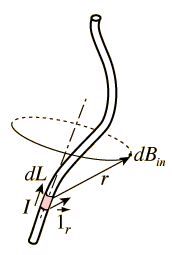
    Statement: The magnetic field ($dB$) due to an infinitesimal small current element ($dl$) at a distance point ($P$) is directly proportional to the current ($I$), element length ($dl$), sine of the angle ($\theta$), and inversely proportional to the square of the distance ($r$).

    ๐Ÿ’ก What is a Current Element?

    It is the small section ($\vec{dl}$) of a conductor taken in the direction of the electric current.

    • Mathematical proportionality: $$dB \propto \frac{I \cdot dl \cdot \sin\theta}{r^2}$$
    • Scalar Equation:$$dB = \frac{\mu_0}{4\pi} \frac{I \cdot dl \cdot \sin\theta}{r^2}$$
    • Vector Form:$$\vec{dB} = \frac{\mu_0}{4\pi} I \frac{\vec{dl} \times \hat{r}}{r^2}$$

    ๐Ÿ” Note: Here, $\mu_0$ is the permeability of free space. Constant Value: $\frac{\mu_0}{4\pi} = 10^{-7} \text{ T}\cdot\text{m}\cdot\text{A}^{-1}$

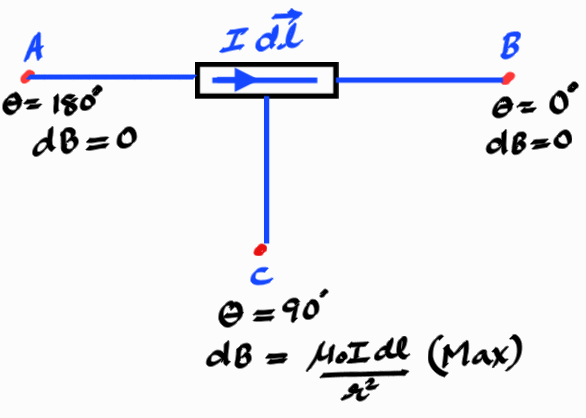
    โšก Special Cases:

    1. Case I (On the Axis Line): If $\theta = 0^\circ$ or $\theta = 180^\circ$, then $\sin\theta = 0$. $$\mathbf{dB = 0 \text{ (Minimum)}}$$ ๐Ÿšฉ The magnetic field is zero at any point along the axial line of the current element.
    2. Case II (On the Equatorial Line): If $\theta = 90^\circ$, then $\sin 90^\circ = 1$. $$\mathbf{dB = \frac{\mu_0}{4\pi}\frac{I \cdot dl}{r^2} \text{ (Maximum)}}$$
    ๐Ÿ“ Solved Examples (NCERT Pattern)

    ๐Ÿš€ Example 1

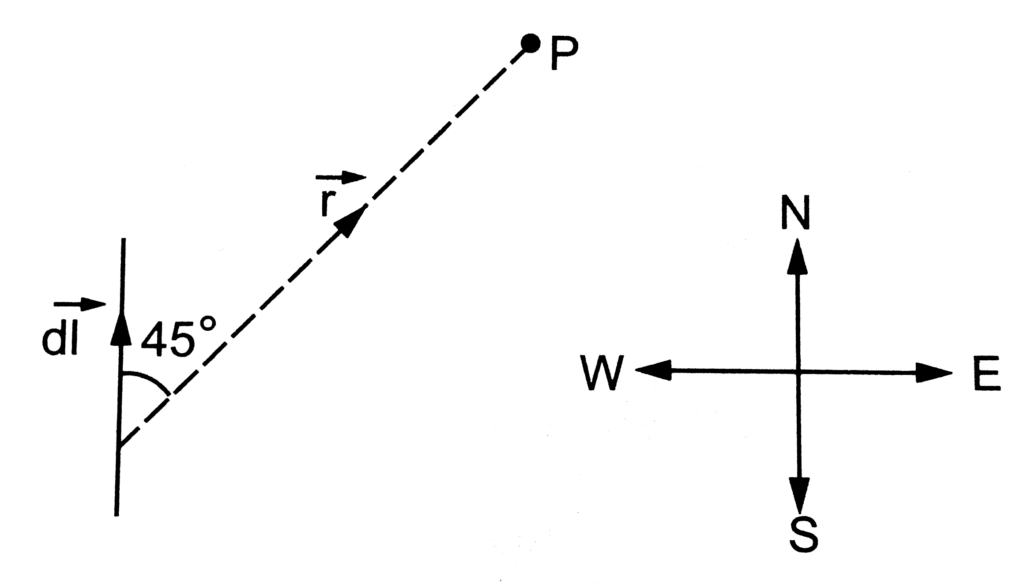
    A wire placed along the north-south direction carries a current of $8\text{ A}$ from south to north. Find the magnetic field due to a $1\text{ cm}$ piece of wire at a point $200\text{ cm}$ north-east from the piece.
    Solution: Given variables:

    • Current, $I = 8\text{ A}$
    • Length, $dl = 1\text{ cm} = 1 \times 10^{-2}\text{ m}$
    • Distance, $r = 200\text{ cm} = 2\text{ m}$
    • Angle (North-East orientation), $\theta = 45^\circ$

    Using Biot-Savart law:

    $$dB = \frac{\mu_0}{4\pi} \cdot \frac{I \cdot dl \cdot \sin\theta}{r^2}$$

    $$dB = (10^{-7}) \cdot \frac{8 \times 1 \times 10^{-2} \times \sin 45^\circ}{2^2}$$

    $$\mathbf{dB = 1.4 \times 10^{-9}\text{ T}}$$

    ๐Ÿ‘‰ Direction: Normally into the plane of the paper.

    ๐Ÿš€ Example 2 [NCERT | OD 19]

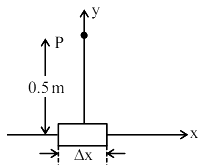
    An element $\Delta\vec{l} = \Delta x \hat{i}$ is placed at the origin and carries a large current $I = 10\text{ A}$. What is the magnetic field on the y-axis at a distance of $0.5\text{ m}$? ($\Delta x = 1\text{ cm}$)
    Solution: Given variables:

    • Current, $I = 10\text{ A}$
    • Length element, $dl = \Delta x = 1\text{ cm} = 10^{-2}\text{ m}$
    • Distance, $r = y = 0.5\text{ m}$
    • Angle between x-axis ($\vec{dl}$) and y-axis ($\vec{r}$), $\theta = 90^\circ$

    Applying Biot-Savart Law:

    $$dB = \frac{\mu_0}{4\pi}\frac{I \cdot dl \cdot \sin\theta}{r^2}$$

    $$dB = \frac{10^{-7} \times 10 \times 10^{-2} \times \sin 90^\circ}{(0.5)^2}$$

    $$\mathbf{dB = 4 \times 10^{-8}\text{ T}}$$

    ๐Ÿ‘‰ Direction: The direction is determined by cross product $\vec{dl} \times \vec{r}$:

    $$\vec{dl} \times \vec{r} = (\Delta x \hat{i}) \times (y \hat{j}) = \Delta x \cdot y (\hat{i} \times \hat{j}) = \Delta x \cdot y \hat{k}$$

    Hence, the field $\vec{dB}$ points along the $+z\text{-direction}$ (Out of the page $\odot$).

    ๐Ÿ  Homework Problems (H.W.)

    Problem 1

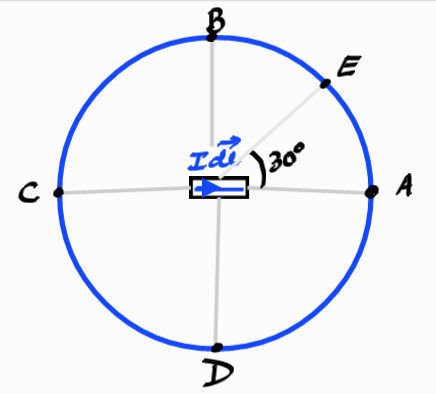
    Given a circle of $1\text{ m}$ radius with a current element $Idl$ placed at its center. Find the magnetic field at boundary points $A, B, C \text{ and } D$.

    $$\left[\text{Given: } \frac{\mu_0 Idl}{4\pi} = 10^{-5}\text{ in SI}\right]$$
    Problem 2

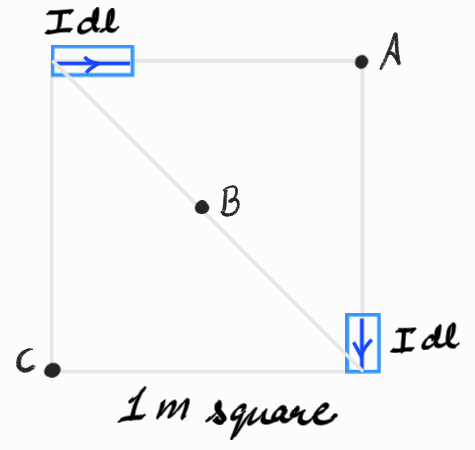
    Find the magnetic field at points $A, B \text{ and } C$ due to a current element $Idl$ placed at the base corner of a square of side length $1\text{ m}$ as shown in the diagram.

    $$\left[\text{Given: } \frac{\mu_0 Idl}{4\pi} = 10^{-5}\text{ in SI}\right]$$
  • Kirchhoff’s Rule Part-3

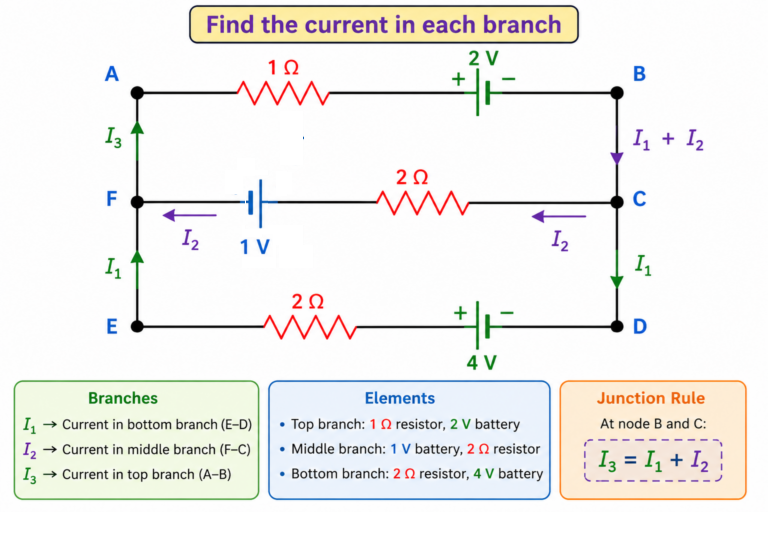
    Q Find the currents in the given circuit

    โšก Find Current in Each Branch

    ๐Ÿ” Given Circuit

    Let the branch currents be:

    • $I_1$ in the lower branch
    • $I$โ€‹ in the middle branch
    • $I_3$โ€‹ in the upper branch

    Using Kirchhoff’s Current Law (KCL) at junction F:I1+I2=I3I_1 + I_2 = I_3


    ๐Ÿ”„ Loop ABCF

    Applying Kirchhoff’s Loop Rule (KVL):โˆ’(I1+I2)(1)โˆ’2โˆ’2I2โˆ’1=0-(I_1+I_2)(1)-2-2I_2-1=0Expanding:โˆ’I1โˆ’I2โˆ’2โˆ’2I2โˆ’1=0-I_1-I_2-2-2I_2-1=0 โˆ’I1โˆ’3I2โˆ’3=0-I_1-3I_2-3=0

    Therefore,I1+3I2=โˆ’3I_1+3I_2=-3

    โœ… Equation (1)


    ๐Ÿ”„ Loop ABDE

    Applying KVL:โˆ’(I1+I2)(1)โˆ’2+4โˆ’2I1=0-(I_1+I_2)(1)-2+4-2I_1=0

    Expanding:โˆ’I1โˆ’I2โˆ’2+4โˆ’2I1=0-I_1-I_2-2+4-2I_1=0โˆ’3I1โˆ’I2+2=0-3I_1-I_2+2=0

    Therefore,3I1+I2=23I_1+I_2=2

    โœ… Equation (2)


    โœ๏ธ Solving Equations (1) and (2)

    From Equation (1):I1+3I2=โˆ’3I_1+3I_2=-3

    Multiply by 3:3I1+9I2=โˆ’93I_1+9I_2=-9

    Equation (2):3I1+I2=23I_1+I_2=2

    Subtracting:8I2=โˆ’118I_2=-11I2=โˆ’118AI_2=-\frac{11}{8}A

    โœ… Current in middle branchI2=โˆ’118A\boxed{I_2=-\frac{11}{8}A}โ€‹


    Substituting into Equation (2):3I1โˆ’118=23I_1-\frac{11}{8}=2 3I1=2783I_1=\frac{27}{8}I1=98AI_1=\frac{9}{8}A

    โœ… Current in lower branchI1=98A\boxed{I_1=\frac{9}{8}A}


    ๐Ÿ”Œ Finding I3I_3

    Using KCL:I3=I1+I2I_3=I_1+I_2โ€‹ I3=98โˆ’118I_3=\frac{9}{8}-\frac{11}{8}โ€‹ I3=โˆ’28I_3=-\frac{2}{8} I3=โˆ’14AI_3=-\frac{1}{4}A

    โœ… Current in upper branchI3=โˆ’14A\boxed{I_3=-\frac{1}{4}A}โ€‹


    ๐ŸŽฏ Final Currents

    โœ… Upper Branch:I3=โˆ’14A\boxed{I_3=-\frac{1}{4}A}โ€‹

    โœ… Middle Branch:I2=โˆ’118A\boxed{I_2=-\frac{11}{8}A}

    โœ… Lower Branch:I1=98A\boxed{I_1=\frac{9}{8}A}


    โšก Find Potential Difference Between A and D

    Using the upper branch:VAโˆ’(โˆ’14ร—1)โˆ’2=VDV_A-\left(-\frac{1}{4}\times1\right)-2=V_D VA+14โˆ’2=VDV_A+\frac{1}{4}-2=V_DVAโˆ’74=VDV_A-\frac{7}{4}=V_D

    Therefore,VDโˆ’VA=โˆ’74VV_D-V_A=-\frac{7}{4}V

    โœ… Potential difference between D and AVDโˆ’VA=โˆ’74V\boxed{V_D-V_A=-\frac{7}{4}V}

    orVAโˆ’VD=74V\boxed{V_A-V_D=\frac{7}{4}V}โ€‹

    ๐ŸŽ‰ Hence, the currents in all branches and the potential difference between A and D have been determined.

  • Kirchhoff’s Loop Rule Part-2

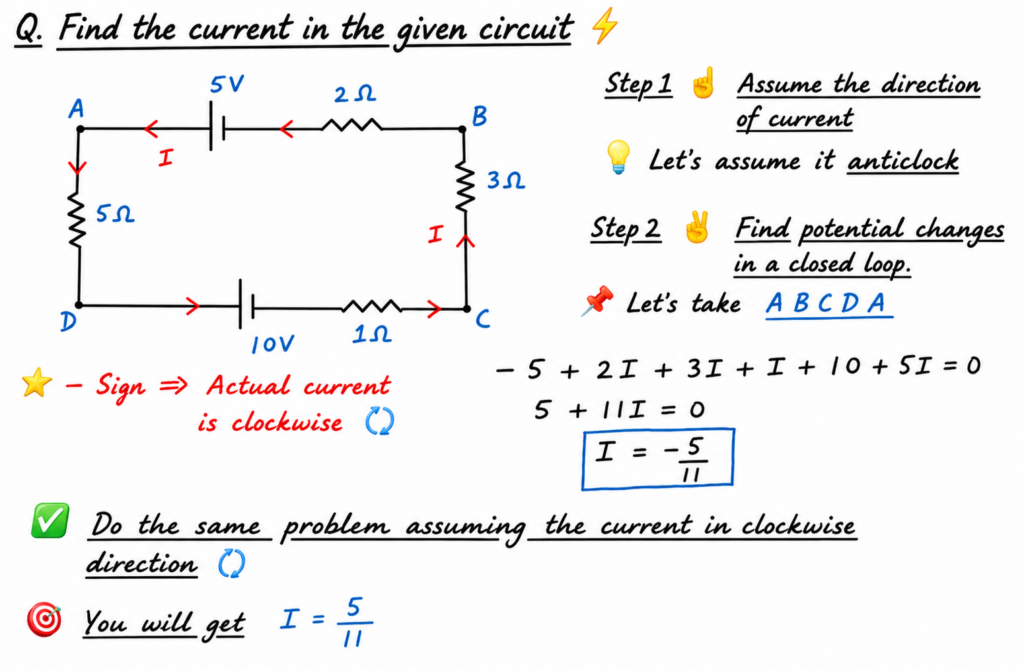
    Q. Find the current in the given circuit โšก

    Step 1: Assume the direction of current โ˜๏ธ

    ๐Ÿ’ก Let’s assume the current is anticlockwise.


    Step 2: Find potential changes in a closed loop โœŒ๏ธ

    ๐Ÿ“Œ Let us take the loop:

    A โ†’ B โ†’ C โ†’ D โ†’ A

    Applying Kirchhoff’s Voltage Law (KVL):โˆ’5+2I+3I+I+10+5I=0-5 + 2I + 3I + I + 10 + 5I = 0

    Combining like terms:5+11I=05 + 11I = 0

    Therefore,I=โˆ’511I = -\frac{5}{11}

    ๐Ÿ“ฆ Answer:I=โˆ’511\boxed{I = -\frac{5}{11}}


    โญ Interpretation of the negative sign

    The negative sign (-) indicates that the actual direction of current is clockwise, opposite to the direction initially assumed.

    ๐Ÿ”„ Actual current direction = Clockwise


    Verification โœ…

    ๐Ÿ”„ Do the same problem again, but this time assume the current to be clockwise.

    ๐ŸŽฏ You will obtain:I=511\boxed{I = \frac{5}{11}}

    โœ… The magnitude of current is 511โ€‰A\frac{5}{11} \, \text{A} and its direction is clockwise.

  • Kirchhoff’s loop rule Part-1

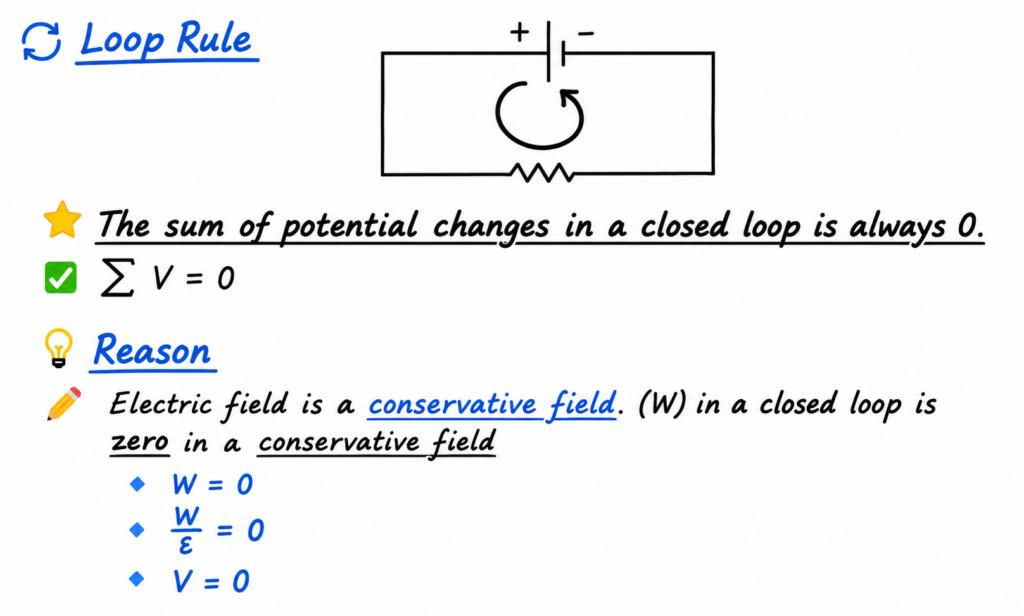
    ๐Ÿ”„ Loop Rule


    โญ The sum of potential changes in a closed loop is always zero.

    โœ…โˆ‘V=0\sum V = 0


    ๐Ÿ’ก Reason

    โœ๏ธ Electric field is a conservative field.

    In a conservative field, the work done (W) in moving a charge around a closed loop is zero.

    Therefore,

    W=0W = 0

    Wq=0\frac{W}{q} = 0

    V=0V = 0


    ๐ŸŽฏ Conclusion

    โœ… Since the electric field is conservative, the net work done around a closed path is zero.

    โœ… Hence, the algebraic sum of all potential rises and potential drops in a closed loop is zero.โˆ‘V=0\sum V = 0

    ๐Ÿ’ก This statement is known as Kirchhoff’s Loop Rule or Kirchhoff’s Voltage Law (KVL). ๐Ÿ”„โšก

    โšก How to Calculate Potential Changes?


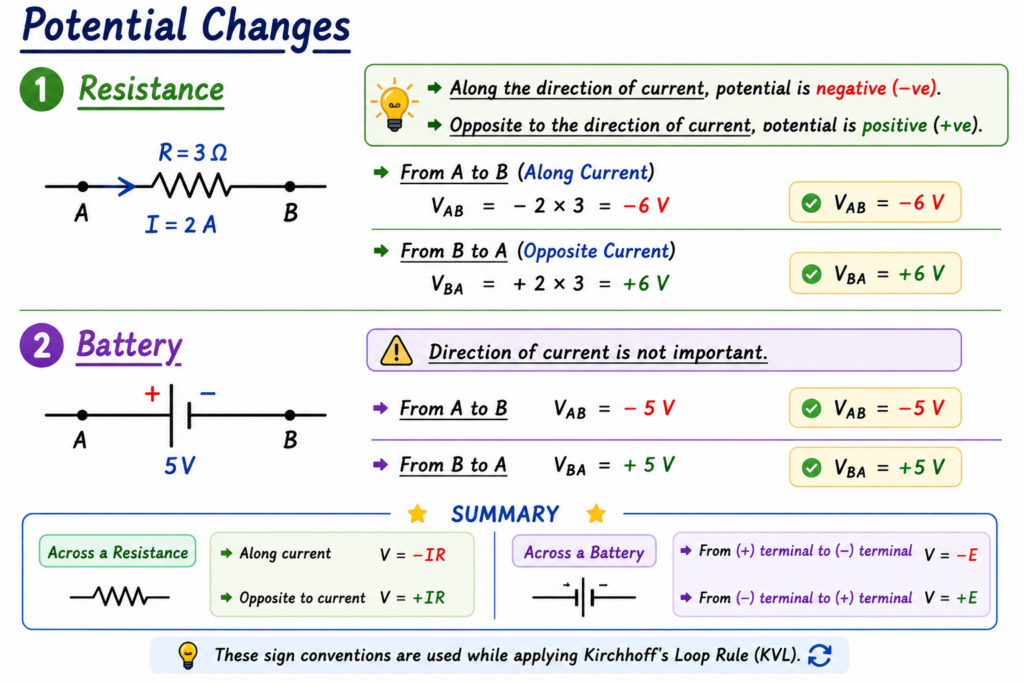
    1๏ธโƒฃ Resistance

    ๐Ÿ”Œ Given

    • Resistance: R = 3 ฮฉ
    • Current: I = 2 A

    ๐Ÿ“Œ Rule

    โžก๏ธ Along the direction of current, potential is negative (โˆ’ve).

    โžก๏ธ Opposite to the direction of current, potential is positive (+ve).

    โœ๏ธ Potential Difference

    From A to B (Along Current)

    VAB=โˆ’2ร—3=โˆ’6VV_{AB} = -2 \times 3 = -6V


    From B to A (Opposite Current)

    VBA=+2ร—3=+6VV_{BA} = +2 \times 3 = +6V


    2๏ธโƒฃ Battery

    ๐Ÿ”‹ Given

    • Battery Voltage: 5V

    ๐Ÿ“Œ Rule

    โš ๏ธ Direction of current is not important.

    โœ๏ธ Potential Difference

    From A to B

    VAB=โˆ’5VV_{AB} = -5V


    From B to A

    VBA=+5VV_{BA} = +5V

    ๐ŸŽฏ Summary

    ๐Ÿ”Œ Across a Resistance

    โžก๏ธ Along currentV=โˆ’IRV = -IR

    โžก๏ธ Opposite to currentV=+IRV = +IR

    ๐Ÿ”‹ Across a Battery

    โžก๏ธ From (+) terminal to (โˆ’) terminalV=โˆ’EV = -E

    โžก๏ธ From (โˆ’) terminal to (+) terminalV=+EV = +E

    ๐Ÿ’ก These sign conventions are used while applying Kirchhoff’s Loop Rule (KVL). ๐Ÿ”„

  • Hello world!

    Welcome to WordPress. This is your first post. Edit or delete it, then start writing!